
What schools need to know
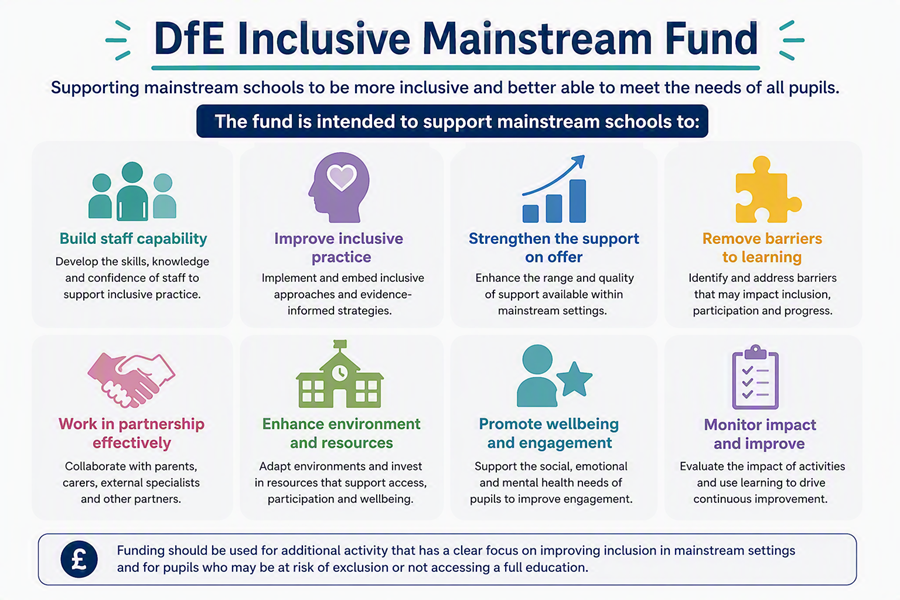
The Inclusive Mainstream Fund is designed to help your school develop and implement its Inclusion Strategy.
1. Eligibility and accessing the funding
The fund is for mainstream state-funded provision for pupils aged 5 to 16 in England. Eligible settings include maintained primary, secondary, middle and all-through schools; academies and free schools in those phases; and city technology colleges.
Maintained schools receive funding through their local authority, while academy trusts are paid directly by the Department for Education.
Funding has already been allocated with one payment covering 26/27, however new schools opening in September 2026, and qualifying growing schools receive later allocations based on October 2026 census data, with confirmation in February 2027 and payment in March 2027.
2. How allocations are calculated
Each school’s allocation is based on:
- a £3,000 lump sum;
- a basic per-pupil amount;
- an additional amount based on the number of pupils recorded as having low prior attainment; and
- an area cost adjustment reflecting geographical differences in labour costs.
The 2026 to 2027 base rates are:
- Primary: £16 for every pupil, including Reception pupils, plus £79 for each eligible low-prior-attaining pupil.
- Secondary: £14 for every pupil up to age 16, plus £88 for each eligible low-prior-attaining pupil.
- Middle and all-through schools receive the appropriate age-related rates
3. Purpose of the fund
The fund is intended to help schools become inclusive by design, identifying and meeting commonly occurring and predictable needs and providing early support without waiting for a diagnosis or statutory process. It sits alongside schools’ core funding and notional SEN budgets rather than replacing them.
It may support improvements to:
- high-quality adaptive teaching;
- inclusive pedagogy and decision-making;
- safe, calm and accessible learning environments; and
- targeted, evidence-based support, including group interventions where required.
The overarching aims are to improve pupils’ attainment and wellbeing and increase parental trust and confidence in the education system.
Make speech, language and communication part of inclusion by design
Speech & Language Link helps schools identify commonly occurring speech, language and communication needs early, understand the barriers these can create and put appropriate support in place without waiting for a diagnosis or statutory process. Its therapist-designed packages combine assessment, staff training, practical resources, planned interventions and specialist support, helping schools strengthen universal provision and provide targeted help where it is needed. Review our speech and language toolkits , sign up for a free trial or get in touch to find out more
This supports the purpose of the Inclusive Mainstream Fund: to build an evidence-informed, inclusive core offer that removes predictable barriers to learning and improves pupils’ access, participation and progress.
4. Permitted use
Schools should use the funding to plan, prepare and embed evidence-informed approaches that strengthen their inclusive core offer for children and young people with SEND. Expenditure should address needs identified across the school’s cohort and remove commonly occurring, predictable barriers to learning.
The DfE recommends that schools consider expenditure across seven themes:
- Ambitious leadership and governance, including cohort analysis, data collection, staff development and peer review.
- Evidence-based support and early intervention.
- High-quality teaching and curriculum design for all learners, supported by appropriate staff training and deployment.
- Accessible and enriching provision beyond the classroom.
- A safe and respectful culture that supports belonging, behaviour and attendance.
- Strong partnerships with families and wider services, including support through transitions.
- Inclusive environments, including classrooms that minimise distraction and support sensory and regulatory needs.
The methodology does not prescribe identical spending for every school. Decisions should be based on the needs of the school’s cohort, the barriers pupils experience and the approaches most likely to be effective in the school’s context. The fund is not a personal budget for individual pupils.
A practical way to invest in early identification and evidence-informed support
Schools may use the Inclusive Mainstream Fund to develop high-quality teaching, staff capability and targeted evidence-based support in response to the needs of their cohort. Speech & Language Link provides assessment tools, staff training, ready-to-use interventions, practical resources and progress information designed by speech and language therapists.
Used as part of a whole-school approach, it can help schools:
- identify speech, language and communication needs early;
- target support according to assessed need;
- equip teaching and support staff with practical strategies and interventions;
- monitor pupils’ progress;
- support communication with families; and
- recognise when specialist speech and language therapy involvement may be required.
5. Accountability and the Inclusion Strategy
Every school receiving the fund must develop and publish an Inclusion Strategy statement by 31 December 2026. The DfE intends this to become an annual requirement, although schools may choose to develop a multi-year strategy. Further guidance and a template are expected.
The strategy should:
- describe the commonly occurring and predictable needs within the school’s cohort;
- identify the barriers to learning experienced by pupils with additional needs;
- explain how existing funding is being used for inclusion;
- set out planned investment based on evidence and best practice;
- describe the activities and approaches the school is implementing; and
- relate expenditure and planned activity to the seven recommended areas of inclusion.
The published strategy must be accessible to parents on the school website. It should be scrutinised by governors or trustees and will be available to Ofsted inspectors when they evaluate inclusion
Turn identified communication needs into a clear, measurable plan
The Inclusion Strategy must explain the commonly occurring and predictable needs within the school’s cohort, the barriers pupils experience, the approaches being taken and how funding supports those approaches.
Speech & Language Link can help schools build this evidence base by providing structured assessments, information to guide targeted support, intervention resources and ways to review progress. Its packages also include training and specialist support to help staff respond consistently to speech, language and communication needs.
This can help schools show a clear sequence from identifying need, through planning and delivering provision, to reviewing progress and refining practice.
Further information can be found on these pages on the DfE website:
Inclusive Mainstream Fund Methodology
Developing an Inclusion Strategy with the Inclusive Mainstream Fund